
Some Thoughts on Bui Thanh Tam’s Paintings
The Path of Vietnamese Art as a Politicized Practice
The narrative of Vietnam’s fine art may be considered under the story of politicizing art
When the French colonial government established Les Beaux-Arts d’Indochine in Vietnam in 1925, the terminology “fine art” lost some of the pure meaning by which it had been understood in the Western world. Here, within the social and cultural environment of an agrarian country [that on the one hand, in the official social and cultural context was influenced strongly by Con-fucianism, a theory that downgrades all art-related careers, and that on the other hand, in the underground social and cultural context was influenced by a folklore cultural spirit that has no concept of author and that uses art practice only with ritualistic and religious purpose] – the concept of Fine Art became political as it was introduced not only as a new technique for making art but also as a new concept for defining the role of art and artist in society.
The second wave of politicizing art in Vietnam was among Vietnamese intellectuals and artists in the 1930s and was presented in the ideological polemic between two viewpoints: “art for art’s sake” and “art for the sake of human life”. This was the first time that a Marxist concept of art and culture publicly attacked the romanticized concept of art.
In this polemic, a romanticized concept of poetry and poets is represented by Xuan Dieu, the king of modern love poetry, in his poem “Cảm xúc” (Feeling), some lines of which can be translated approximately as:
‘Being the poet means singing lullaby with the wind Dreaming to the moon
Floating with the cloud
Or sharing feelings with a thousand loves.’
It was attacked by Truong Chinh, later general secretary of the Vietnam Communist Party, in his parody “Là thi sĩ” (Being a Poet), the lines of which can be translated approximately as:
‘Being a poet means singing to celebrate
The global struggle
Against the cruel invaders in five continents
Means standing up and waving the democratic flag around the globe
And using the pen as a weapon to make revolution
Making each line of poem as bullets and bombs to
Destroy the power’ (3)
It is in view of the above that I would like to discuss the paintings of Bui Thanh Tam as a third wave of politicizing art in Vietnam.
The Paintings of Bui Thanh Tam
Those who are familiar with Chinese contemporary art of the 1990s may not be strangers to the Gaudy Art movement, one of three popular art movements of that time (the two others are Cynical Realism and Political Pop). The term Gaudy Art was coined by the art critic Li Xiangting for artists who appropriated bright folk art aesthetics in combination with issues of commodity culture.
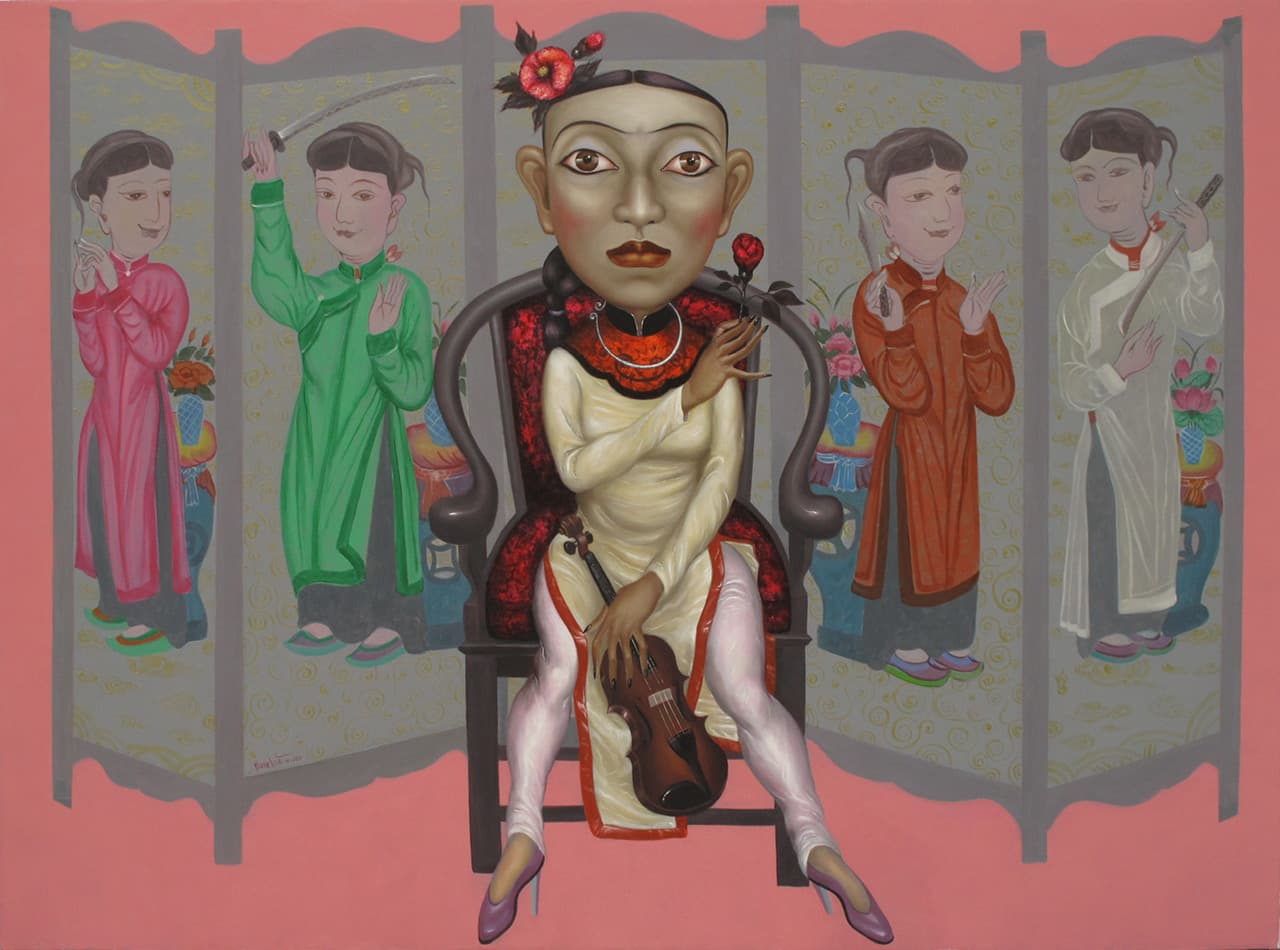
The paintings of Bui Thanh Tam display bright, pure colors whose harmony reminds us of the five-color system of Dong Ho folk paintings, and the intent has been clearly mentioned by the artist: “It is a parody of the absurd and ridiculous, at times sad, things that are happening in my contemporary society.” And the reason for this parody is that the artist “is fascinated by the people and their lust for luxury and appearance, for material things, for consumerism and conformity. They forget where they are from, they forget their traditions, their culture and they seem to assimilate only those aspects that make them appear rich and fabulous, trendy and fashionable and enviable.”
Bearing in mind these two factors in his paintings, a relationship between Bui Thanh Tam’s art and the Gaudy Art movement of Chinese artists of the 1990s becomes apparent. Two of these factors also make Bui Thanh Tam’s art “political”: they are the direct “texts” of Vietnam’s current social and cultural changes.
To me, the paintings reflect social and cultural issues as Bui Thanh Tam displays a two-layered change in the development of Vietnamese paintings. The first layer: by his direct and parodic view of Vietnam’s reality, Tam committedly challenges the traditional painting style which is either semi-abstract (for example, Dang Xuan Hoa’s works) or kitsch (for example, Hong Viet Dung or Nguyen Thanh Binh’s works), the style of the famous Vietnamese painters of the 1990s. In this regard, Bui Thanh Tam's paintings are political.
However, if the politicizing of art in Vietnam before was either politically modernist (in colonial times), or ideological (the polemic on art for art’s sake or art for human life’s sake of the 1930s, or the Intellectual Dissidence of the 1950s: The Nhân Văn–Giai Phâm Affair in the 1950s), the politicizing of art by Bui Thanh Tam is more complicated.
Depicted in his paintings are female figures in different poses and costumes from which we seem able to portray the current face of Vietnam, one that is globalized and illustrates the conflicts between new and old values. In this conflict, no social entity – aesthetic, political, or cultural – can be safe from each other. Traditional values are challenged by modern ones, Vietnamese-ness is challenged by global-ness, and the old is challenged by the new, etc. While all of these entities challenge each other on the surface, they are the very reason for the existence of each other as the fundamental of society. In fact, they are two sides of the same chaotic movement. Understood in this way, we can see that what the painter depicts is not some kind of accusation of the new values or the defence of the old values, but only the neutral presentation – with his cold eyes – of the unprecedented transition of Vietnam’s current society.
In an article published in the online magazine www.widewalls.ch, the author Lorenzo Pereira thinks that Bui Thanh Tam’s paintings also question the role of females in Vietnam society. I totally agree with this observation. From an intertextual perspective, Bui Thanh Tam’s paintings of female figures remind us of a Vietnamese traditional format for painting: Tranh To Nu (painting of beautiful ladies). To summarize, this traditional format of painting is part of the Hàng Trong style of painting, which always depicts four female figures in four separate paintings (Tu bình). These four figures are always depicted standing and playing different traditional music instruments to display the peaceful and gentle beauty and demeanor of the traditional Vietnamese woman.
With an intertextual context in mind, the audiences will associate Tam’s paintings with traditional Tranh To Nu. Rather than depicting Vietnamese ladies standing in the traditional poses with musical instruments in their hands as in Tranh To Nu, Bui Thanh Tam depicts them in more vulgar poses such as standing with legs stretched wide apart or lying on the floor with cigarettes or glasses of wine in their hands. Associating Bui Thanh Tam's paintings with Tranh To Nu opens a more complicated message in Tam’s paintings. Once again, the painter does not try to attack the new ways or defend the old ways, he only tries to present two different sides of the unprecedented transition.
Conclusion
Bui Thanh Tam belongs to the fourth generation of Vietnamese artists(who emerged after the 1990s and who still believe in Painting – not in terms of its ability to imitate or make something beautiful, but as being of critical/political essence. From this perspective, the influence of Gaudy Art on his art is understandable. However, may I make one thing clear: the influence mentioned here is not the copying of style, which is less creative and which should not be promoted, but a discursive one that arises from the similarities in the political, cultural and social frameworks of Vietnam and China as they open up to the Western world and its influences, and because they provide many similar critical/political issues for artists in both countries.
It is the intertextual view of these two practices, Gaudy Art in China of the 1990s, and the political paintings of young Vietnamese artists of the 2010s that will give us a deeper under- standing not only art development itself but also the political, social and cultural space in the two countries, which contain many conflicts of values and which, because of this, also provide many possibilities and new visions.
Nguyễn Như Huy
Curator, art critics
1. Political modernity is something that is imposed on non-Western nations by Western institutions. Read further in `Provincializing Europe”, D. Charkrabarty, published by Princeton University Press (2007).
2. In a very interesting article, Phoebe Scott, curator at Singapore National Gallery, wrote about the first time the role of the artist in society was discussed in official magazines in Vietnam in the 1930s. This role was discriminated from two other roles: intellectual and craftsman. “Châm biếm các họa sĩ châm biếm mỹ thuật”, Phoebe Scott, Tạp chí nghiên cứu mỹ thuật (April, 2008).
3. Read further in the article “Nhìn lại Hải Triều và cuộc tranh luận nghệ thuật năm 1936–1939 ở Việt Nam” (“Looking back at Hai Trieu and the polemic of art in 1936–1939”, published in the blog of of literary critic Tran Đình Su:
https://trandinhsu.wordpress.com/2014/09/29/nhin-lai-cuoc-tranh-luan-nghe-thuat-cua-hai-trieu- nhan-60-nam-mat-cua-ong/).
THERE IS NO BOx

GateGate Gallery được thành lập như một điểm kết nối giữa nghệ sĩ trẻ tiềm năng, nghệ sĩ thành danh tại Việt Nam, và nghệ sĩ Việt Nam tại nước ngoài.
230/18 Pasteur, Vo Thi Sau Ward, District 3, HCMC, Vietnam
Opening Hours: Tue - Sun, 10am - 6pm
Tel: +84 96 137 6855
Email: gategate.gallery@gmail.com